July 14, 2026
Reliable Performance Under High Pressure & Temperature: The Critical Role of Floating Head Heat Exchangers in Oil Refineries
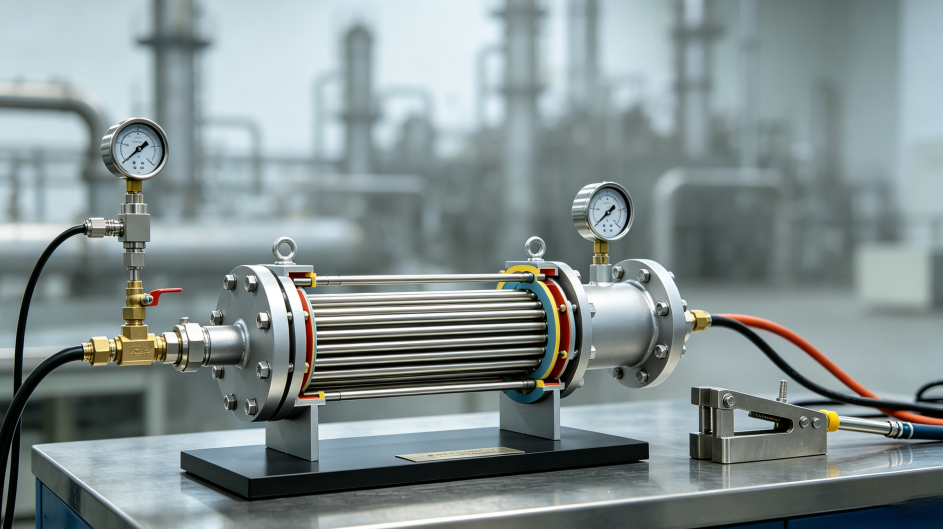
Floating head heat exchangers are indispensable in refinery and petrochemical services where large temperature differentials exist between the shell-side and tube-side fluids, or where frequent cleaning is required. By allowing the tube bundle to expand and contract independently of the shell, the floating head design eliminates thermal stress and maintains reliable operation under the most demanding high-pressure, high-temperature process conditions.
What Is a Floating Head Heat Exchanger?
The defining feature of a floating head heat exchanger is its floating tubesheet at the rear end. One tubesheet is fixed to the shell, while the other—the floating head—can move freely inside the shell to accommodate thermal expansion. This design ensures that tube expansion due to heat does not impose stress on the shell or create mechanical failure points.
The floating head assembly typically consists of a floating tubesheet, a hook ring, and a floating head cover, forming a detachable connection that allows the entire tube bundle to be withdrawn from the shell for cleaning and inspection.
Because the tubes and shell are free to expand independently, thermal expansion does not create damaging stress. This is the single most important advantage of the floating head design, and it is what makes the exchanger suitable for applications involving severe temperature gradients.
Key Performance Parameters
Floating head heat exchangers are engineered to operate under extreme conditions that would cause fixed tubesheet designs to fail.
Parameter | Typical Range / Capability |
Design Temperature | Up to 500°C |
Design Pressure | Up to 6.4 MPa (64 bar) standard; up to 10 MPa for high-pressure designs |
Shell Diameter | 100 mm to 2,500 mm |
Tube Diameter | 6 mm to 50 mm |
Tube Length | Up to 6 meters (custom designs available) |
Materials of Construction | Carbon steel, stainless steel (304, 316), duplex steel, titanium, Hastelloy |
Design Codes | ASME VIII-1, TEMA, API 660 |
Note: The widely referenced general operating envelope is temperature ≤450°C and pressure ≤6.4MPa. For demanding applications, custom designs with higher ratings are available.
Why Refineries Prefer Floating Head Heat Exchangers
Refineries process crude oil through multiple heating, cooling, condensation, and vaporization stages. These operations consistently involve high temperatures, high pressures, frequent thermal cycling, fouling fluids, and continuous 24/7 operation.
Under such conditions, thermal expansion is a major concern. The floating head design allows the tube bundle to expand independently from the shell, minimizing thermal stress and improving long-term reliability. In addition, the removable tube bundle simplifies maintenance and cleaning, reducing costly shutdowns.
Eliminating Thermal Stress
In fixed tubesheet exchangers, when the tubes are hotter than the shell, the tubes try to elongate but are restrained by the fixed tubesheets. This generates compressive stress on the tubes and tensile stress on the shell, leading to tube buckling, tube-to-tubesheet joint failure, or shell distortion over time.
The floating head design eliminates this problem entirely. Because the rear tubesheet can move freely, the tube bundle expands without constraint, and no differential thermal stress develops. This is why floating head exchangers are specified whenever the temperature difference between shell-side and tube-side fluids exceeds approximately 100–150°C, or when thermal cycling is frequent.
Maintenance Accessibility
The removable tube bundle is a critical operational advantage. The floating head can be disassembled, and the entire tube bundle can be pulled out from the shell for inspection, cleaning, or replacement. This is particularly valuable when processing fouling fluids, as it allows mechanical cleaning of both the tube exterior and the shell interior.
Faster cleaning translates to reduced downtime. Routine maintenance that would require extensive scaffolding or confined-space entry with other designs can be completed on the shop floor with the pulled bundle. For refinery operators, the ability to clean tubes quickly and thoroughly directly improves plant availability and reduces lifecycle costs.
Critical Applications in Oil Refineries
Crude Oil Preheating Systems
Before crude oil enters the atmospheric distillation column, it must be heated to the required process temperature. Floating head heat exchangers recover heat from hot process streams to preheat the crude feed, reducing furnace fuel consumption and improving overall refinery energy efficiency. Because crude oil often contains contaminants and deposits, the ability to remove and clean the tube bundle is particularly valuable.
Atmospheric and Vacuum Distillation Units
In atmospheric distillation—the first major separation process in a refinery—heat exchangers perform multiple critical functions: feed heating before entry into the tower, product cooling before storage or further processing, and heat recovery from hot streams to cooler process streams.
Vacuum distillation processes heavy crude fractions at reduced pressures, operating at elevated temperatures with high thermal gradients and heavy hydrocarbon streams. The floating head design effectively handles thermal expansion while allowing easier maintenance when fouling occurs.
Diesel, Gasoline, and Kerosene Cooling
Product cooling is another major refinery application. Floating head heat exchangers are used to cool diesel, gasoline, kerosene, naphtha, and fuel oil, ensuring stable operation under continuous service conditions.
Heat Recovery Networks
Modern refineries prioritize energy efficiency. Floating head heat exchangers play an important role in heat integration systems, energy recovery networks, and process optimization projects, reducing utility consumption and improving plant profitability.
Petrochemical Applications
In petrochemical plants, floating head heat exchangers are used extensively in:
Ethylene production: Process heating and cooling throughout cracking operations
Aromatics production: Heat transfer for benzene, toluene, and xylene processing units
Polymer manufacturing: Temperature control during resin and polymer production
Solvent recovery systems: Recovery and recycling of valuable process solvents
Design Standards and Engineering Considerations
API 660
API 660 is the American Petroleum Institute standard for shell-and-tube heat exchangers in the oil, gas, and petrochemical industries. It specifies design, materials, testing, and inspection requirements to ensure safety and reliability in high-pressure, high-temperature, and corrosive environments. Floating head exchangers are explicitly covered under API 660 for removable-bundle construction.
The standard states that floating head heat exchangers should be used in all services where fixed tubesheet or U-tube bundles are not allowed.
Material Selection
Material selection is critical for refinery service. Common materials include carbon steel for general duty, stainless steel (304, 316) for corrosive service, duplex steel for chloride stress corrosion resistance, and titanium or Hastelloy for severe corrosive or high-temperature applications.
TEMA Classifications
TEMA (Tubular Exchanger Manufacturers Association) standards classify floating head exchangers into types such as:
AES: Removable floating head with split backing ring
BES: Fixed tubesheet with floating head
BJS: Fixed tubesheet with outside-packed floating head
Advantages and Limitations
Advantages
Advantage | Description |
No thermal stress | Tube bundle expands independently from shell |
Removable bundle | Full access for cleaning and inspection |
High temperature capability | Up to 500°C |
High pressure capability | Up to 10 MPa |
Fouling service suitable | Easy mechanical cleaning of tubes |
Corrosion service suitable | Wide range of metallurgies available |
Limitations
Limitation | Description |
Higher cost | Approximately 20% more expensive than fixed tubesheet designs |
Complex construction | More parts and tighter tolerances required |
Internal leakage risk | Floating head seal can be difficult to inspect |
Heavier equipment | More material consumption than simpler designs |
Conclusion
The floating head heat exchanger remains one of the most trusted heat exchanger designs for demanding refinery process environments. Its ability to handle high temperatures and pressures, combined with the removable tube bundle that simplifies maintenance and cleaning, makes it essential for applications involving:
Large temperature differences between shell-side and tube-side fluids
Frequent thermal cycling
Fouling or corrosive fluids
Continuous refinery operation requiring high reliability and maintainability
When specifying a floating head heat exchanger for refinery service, engineers should reference API 660 for mechanical design requirements, ASME VIII-1 for pressure vessel construction, and TEMA standards for classification and design details. Proper material selection—from carbon steel to duplex or titanium alloys—ensures long-term performance under the specific corrosion and temperature conditions of each service.
The floating head exchanger does not eliminate the need for maintenance, but it makes maintenance faster, more thorough, and less costly. In an industry where unplanned downtime can cost millions of dollars per day, that is a critical advantage.