July 14, 2026
Understanding TEMA Standards: How to Customize Your Floating Head Heat Exchanger (AES, AEL, etc.)
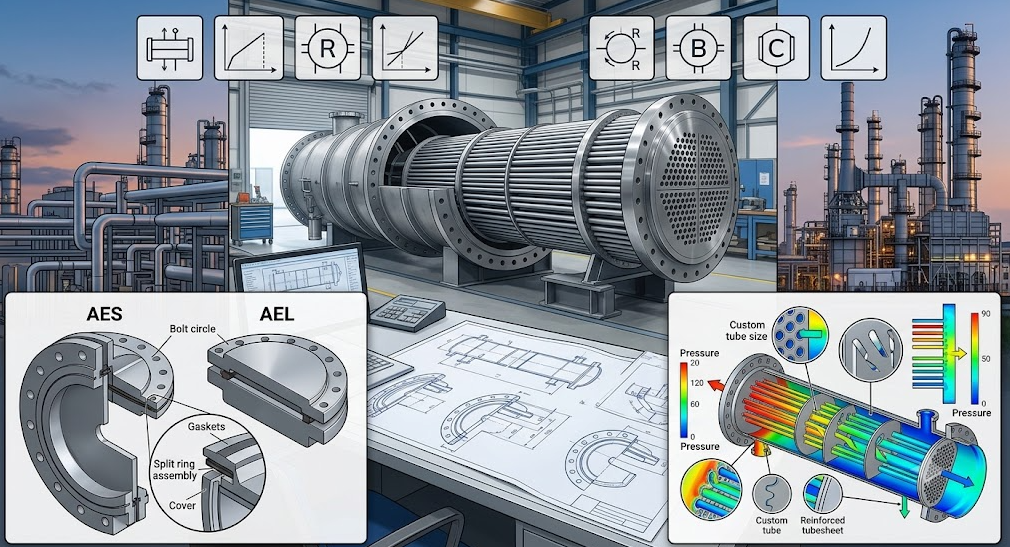
Table of Contents
What is TEMA and Why Does It Matter?
The TEMA Three-Letter Nomenclature System
Floating Head Designs: Types S, T, and P
Fixed Tubesheet Designs: AEL, BEM, and NEN
How to Customize Your Floating Head Heat Exchanger
TEMA Classes: R, B, and C
Selection Criteria: Which Type for Which Service?
Frequently Asked Questions
Summary
What is TEMA and Why Does It Matter?
The Tubular Exchanger Manufacturers Association (TEMA) is a US-based association of leading manufacturers of shell-and-tube heat exchangers. Founded in 1939, TEMA has been a pioneer in heat exchanger research and development. TEMA standards have gained worldwide recognition as the definitive authority on the mechanical design of shell-and-tube heat exchangers.
The widely adopted standards established by TEMA cover:
Mechanical design rules that ensure strength and reliability
A nomenclature system that classifies heat exchanger configurations
Material, fabrication, and tolerance guidelines
Application recommendations for different industrial services
For procurement engineers, EPC contractors, and project managers, specifying the correct TEMA designation is critical. Specifying BEM in a service requiring AES will lead to fouling and performance degradation within a year. Conversely, specifying AES where BEM would suffice adds significant cost without delivering value.
The TEMA Three-Letter Nomenclature System
The TEMA letter code consists of three parts, each identifying a specific design feature:
Position | What It Defines | Common Letters |
First letter | Front-end head type (stationary) | A, B, C, D, N |
Second letter | Shell type (flow pattern) | E, F, G, H, J, K, X |
Third letter | Rear-end head type (thermal expansion handling) | L, M, N, P, S, T, U |
Front-End Head Types (First Letter)
A – Channel with removable cover. Bolted channel cover can be removed for tube bundle inspection. Standard refinery service requiring frequent tube inspection.
B – Bonnet (integral cover). Welded or forged bonnet; must be removed as a unit for bundle access. Lower cost, less frequent maintenance.
C – Channel integral with tubesheet and removable cover. Channel welded to tubesheet. High-pressure services, hazardous fluids.
N – Channel with removable cover for fixed tubesheet design.
Shell Types (Second Letter)
E – Single-pass shell. The most common shell type.
F – Two-pass shell with longitudinal baffle.
G – Split-flow shell.
H – Double-split flow shell.
J – Divided-flow shell.
K – Kettle reboiler shell.
X – Cross-flow shell.
Rear-End Head Types (Third Letter)
L – Fixed tubesheet (non-removable bundle).
M – Floating head with outside packing.
N – Fixed tubesheet with no floating head.
P – Outside packing floating head with split backing ring.
S – Floating head with backing device (split ring).
T – Pull-through floating head.
U – U-tube bundle.
Example: AES Decoded
A – Channel with removable cover (front end)
E – Single-pass shell
S – Floating head with backing device (rear end)
A complete TEMA specification also includes nominal shell diameter (inches) and nominal tube length (inches). For example: "AES 27-240" indicates TEMA type AES, with a 27-inch shell diameter and 240-inch tube length.
Floating Head Designs: Types S, T, and P
Floating head designs allow the tube bundle to expand independently from the shell, eliminating thermal stress and permitting bundle withdrawal for cleaning and maintenance.
Type S: Split Backing Ring Floating Head (AES, BES, etc.)
Design: The floating head is secured by a split backing ring. This is the standard design for refineries handling fouling services that require mechanical cleaning on both sides.
Advantages:
Floating head design allows thermal expansion
Higher heat transfer area than pull-through designs (AET/BET)
Multiple tube passes available
Better thermal shock resistance than AEW/BEW designs
Suitable for volatile or toxic fluids
Disadvantages:
Bundle withdrawal requires removing shell cover, split ring, and floating head cover – higher maintenance costs
More expensive than fixed tubesheet and U-tube designs
Recommended for: Services requiring frequent bundle withdrawal.
Type T: Pull-Through Floating Head (AET, BET, etc.)
Design: The floating head is bolted directly to the floating tubesheet, allowing the bundle to be withdrawn together with the floating head.
Advantages:
Floating head design allows thermal expansion
Shell side can be inspected and mechanically cleaned
Large shell-side nozzle inlet area provides uniform distribution across the bundle
Multiple tube passes available
Suitable for volatile or toxic fluids
Disadvantages:
The most expensive of all shell-and-tube designs
Type P: Outside Packing Floating Head (AEP, BEP, etc.)
Design: Uses a packing gland outside the shell to seal the floating tubesheet.
Advantages:
Lower cost than fully internal floating head types
Packing is not exposed to tube-side fluid
Disadvantages:
TEMA does not recommend Type P for nominal shell diameters exceeding 60 inches
Fixed Tubesheet Designs: AEL, BEM, and NEN
Fixed tubesheet designs are the simplest and most economical, but they do not accommodate thermal expansion and do not allow bundle withdrawal.
Type L: Fixed Tubesheet (AEL, BEM, NEN)
Design: Both tubesheets are welded to the shell, and the bundle cannot move freely. An expansion joint is installed on the shell to compensate for differential expansion.
Advantages:
Most economical design
Multiple tube passes available
Disadvantages:
Shell side requires chemical cleaning
Cannot absorb thermal expansion between shell and tubes
Bundle is not removable
How to Customize Your Floating Head Heat Exchanger
Customizing a TEMA floating head heat exchanger involves selecting from multiple design parameters:
1. TEMA Class
Class | Service | Description |
R | Refinery | Heavy-duty exchangers for high-temperature, high-pressure refinery and petrochemical services |
B | Chemical | Designed specifically for the chemical process industry, balancing durability and economy |
C | Commercial | General-purpose exchangers for moderate-duty applications like HVAC and light industry |
2. Construction Materials
Carbon steel – General service
Stainless steel (304, 316, Duplex) – Corrosive services
Nickel alloys – High-temperature, highly corrosive services
Titanium – Seawater or severely corrosive services
Copper alloys – Seawater cooling
3. Number of Tube Passes
Floating head exchangers can be configured with 1, 2, 4, or 6 tube passes.
4. Nozzle Sizes and Locations
Custom nozzle sizes and positions can be specified to match piping connections and reduce pressure drop.
5. Baffle Design
Segmental baffles – Most common, good heat transfer
Double-segmental baffles – Lower pressure drop
No tubes in window – For high-fouling services
6. Expansion Joints
Fixed tubesheet designs may require an expansion joint on the shell. Floating head designs eliminate this need entirely.
7. TEMA Data Sheet
The TEMA heat exchanger data sheet is a standard document for defining design requirements. It includes sections for:
Service identification
Operating conditions
Thermal design data
Mechanical design data
Construction materials
Testing and inspection requirements
8. Third-Party Codes
Most custom exchangers are designed to ASME Section VIII, Division 1, with possible additional requirements for:
ASME Section III N-stamp – Nuclear service
API 660 – Petroleum and petrochemical service
Customer-specific specifications
Selection Criteria: Which Type for Which Service?
Service Characteristic | Recommended Type | Rationale |
Clean fluids, low maintenance | BEM, AEL, NEN (fixed tubesheet) | Lowest cost, simple construction |
Fouling fluids, frequent cleaning | AES, BES (split-ring floating head) | Removable bundle, mechanical cleaning on both sides |
Large temperature differential, frequent cleaning | AET, BET (pull-through floating head) | Fully removable bundle, accommodates thermal expansion |
High thermal shock | BEU, AEU (U-tube) | Each tube expands independently |
Moderate fouling, cost-sensitive | AEP, BEP (packed floating head) | Lower cost than internal floating heads |
High pressure, hazardous fluids | AES, BES with Class R | Robust design, accommodates toxic fluids |
Frequently Asked Questions
Q: What is the difference between AES and AEL?
A: AES is a floating head design (third letter S) with a removable bundle, suitable for fouling services and frequent cleaning. AEL is a fixed tubesheet design (third letter L) with a non-removable bundle – lower cost but cannot accommodate thermal expansion or allow shell-side mechanical cleaning.
Q: What is the most common TEMA type in refineries?
A: AES (removable channel, single-pass shell, split-ring floating head) is the standard design for refinery fouling services requiring mechanical cleaning on both sides.
Q: What does the "S" in AES stand for?
A: "S" denotes a floating head with a backing device (split backing ring floating head).
Q: Can TEMA heat exchanger materials be customized?
A: Yes. TEMA exchangers can be fabricated from carbon steel, stainless steel, nickel alloys, titanium, copper alloys, and other materials depending on service requirements.
Q: What is the most expensive TEMA floating head type?
A: AET/BET (pull-through floating head) is the most costly of all shell-and-tube designs.
Q: Which TEMA class should be selected for refinery service?
A: Class R (refinery service) is the appropriate TEMA class for high-temperature, high-pressure refinery and petrochemical applications.
Q: How do I specify a TEMA heat exchanger?
A: Use the three-letter designation (e.g., AES 27-240) plus shell diameter and tube length, specify the TEMA class (R, B, or C), construction materials, operating conditions, and fill out any additional requirements on the TEMA data sheet.
Summary
The TEMA three-letter nomenclature system provides a universal language for shell-and-tube heat exchanger specification. Understanding what each letter means – and how the different rear-head designs handle thermal expansion, bundle withdrawal, and maintenance – is essential for selecting the right exchanger for your application.
For floating head designs, the choice between Type S (split ring), Type T (pull-through), and Type P (packed) involves trade-offs between cost, maintenance convenience, and thermal performance.
AES is the refinery standard – reliable, maintainable, and cost-effective for fouling services.
AET offers the best bundle withdrawal access but comes at the highest cost.
AEP provides a lower-cost floating head option for less demanding services.
When customizing an exchanger, consider the TEMA class, materials, tube pass arrangement, and any additional code requirements. Proper specification ensures decades of reliable operation.