August 11, 2026
What Temperature Range Can Jacket Heating Reactor Reach (Low Temp / Medium Temp / High Temp)
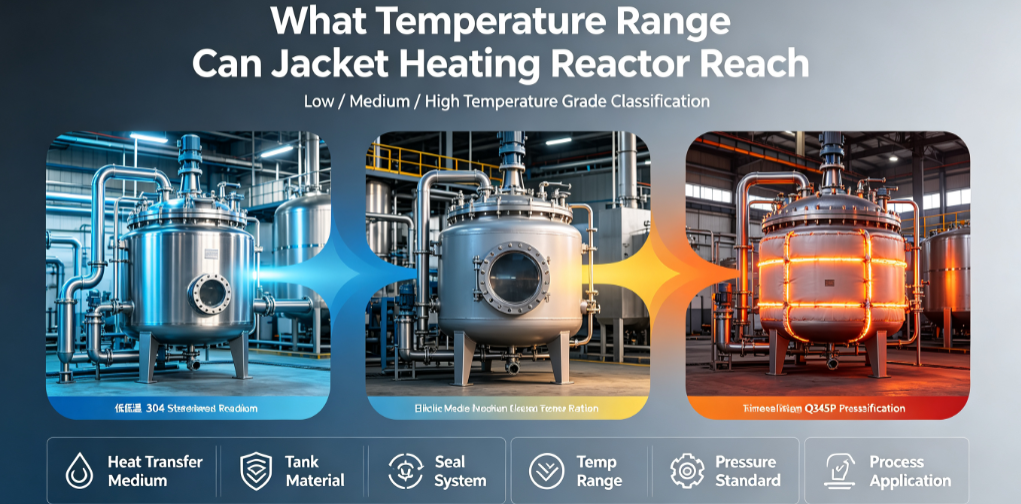
Table of Contents
1. Core Heating Principle of Jacket Heating Reactor
2. Full Temperature Classification Standard For Jacket Heating Reactor 2.1 Low Temperature Jacket Heating Reactor: Working Temp, Heat Medium & Application 2.2 Medium Temperature Jacket Heating Reactor: Working Temp, Heat Medium & Application 2.3 High Temperature Jacket Heating Reactor: Working Temp, Heat Medium & Application
3. 4 Key Factors That Decide Actual Reactor Jacket Temperature Limit 3.1 Type Of Circulating Heat Conduction Medium 3.2 Jacket & Tank Wall Thickness Material Grade 3.3 Heating Power Matching & Circulation Pump Flow Rate 3.4 Temperature Control Unit Cooling & Heat Exchange Capacity
4. Performance Comparison: Low / Medium / High Temp Jacket Heating Reactor
5. Standard Production Process To Meet Different Jacket Temperature Demands
6. Main Industrial Matching Application Scenarios By Temperature Grade
7. Step-by-Step Selection Guide For Chemical Plant Equipment Purchasers
8. Common Operation Faults Caused By Mismatched Jacket Heating Temperature Grade
9. Industry FAQ For Jacket Heating Reactor Temperature Control & Medium Matching
1. Core Heating Principle of Jacket Heating Reactor
Jacket heating reactor wraps a hollow interlayer (jacket) around the outer wall of reaction tank. Hot heat conduction medium circulates inside the jacket cavity, transferring heat through metal wall to internal raw materials for heating, thermal insulation or constant-temperature reaction.
Different heat medium has distinct boiling point, thermal stability and maximum safe service temperature. That’s the root reason why jacket reactors are split into low, medium and high temperature grades. Many buyers confuse the medium’s max temperature with reactor internal material temperature. We need to distinguish jacket circulation medium temperature and actual inner tank reaction temperature separately in all test standards.
2. Full Temperature Classification Standard For Jacket Heating Reactor
Industry unified classification standard follows chemical equipment HG/T 20564 jacket reactor specification, divided into low, medium, high temperature three grades based on jacket circulating medium stable operating range.
2.1 Low Temperature Jacket Heating Reactor: Working Temp, Heat Medium & Application
· Jacket circulating medium temperature range: 20℃ ~ 95℃
· Main heat conduction medium: Clean industrial hot water, glycol water mixed anti-freeze solution
· Stable long-term continuous working upper limit: Max 95℃, cannot exceed 100℃ under normal pressure (water boiling point limit)
· Actual internal reactor material reaction temperature: 10℃ ~ 85℃
· Core feature: Low operation pressure inside jacket, low energy consumption, no high-temperature aging risk of sealing gaskets
· Typical application: Food fermentation, mild cosmetic blending, low-temperature biological enzyme reaction, dairy raw material constant temperature mixing
2.2 Medium Temperature Jacket Heating Reactor: Working Temp, Heat Medium & Application
· Jacket circulating medium temperature range: 100℃ ~ 220℃
· Main heat conduction medium: Ordinary mineral thermal conductive oil (standard synthetic heat transfer oil)
· Stable long-term continuous working upper limit: 220℃, short-time peak allowable 230℃
· Actual internal reactor material reaction temperature: 50℃ ~ 200℃
· Core feature: Medium thermal oil has good fluidity within 220℃, low vapor pressure, jacket closed circulation without high-pressure steam system
· Typical application: Daily chemical synthesis, resin preliminary polymerization, pesticide intermediate mild heating reaction, coating raw material dissolving
2.3 High Temperature Jacket Heating Reactor: Working Temp, Heat Medium & Application
· Jacket circulating medium temperature range: 230℃ ~ 350℃
· Main heat conduction medium: High-temperature resistant fully synthetic aromatic thermal conductive oil
· Stable long-term continuous working upper limit: 350℃, short-time instantaneous peak 360℃
· Actual internal reactor material reaction temperature: 180℃ ~ 330℃
· Core feature: Special high temp oil resists carbonization at over 300℃, reactor tank body must adopt thickened high-temperature resistant stainless steel plate, high-temperature resistant graphite sealing assembly
· Typical application: High molecular polymer polymerization, asphalt modification, high-temperature solvent distillation, fine chemical high-temperature catalytic synthesis
3. 4 Key Factors That Decide Actual Reactor Jacket Temperature Limit
3.1 Type Of Circulating Heat Conduction Medium
This is the most decisive factor. Hot water cannot break 100℃; standard thermal oil fails to keep stable above 220℃; only special high-temp aromatic oil can reach 350℃. If mis-match medium grade, oil carbonizes rapidly and blocks jacket circulation pipeline.
3.2 Jacket & Tank Wall Thickness Material Grade
304 stainless steel jacket reactor only supports max medium temp 280℃. 316L or Q345R pressure vessel steel must be used for 300℃+ high temp jacket system. Thin wall tank will produce large thermal deformation under over 300℃ long heating cycle.
3.3 Heating Power Matching & Circulation Pump Flow Rate
Insufficient pump flow leads to local medium overheating inside jacket, even high-temp oil will carbonize at local dead zone. Heating power over design standard creates instant temperature overshoot beyond rated upper limit, damage reactor sealing parts.
3.4 Temperature Control Unit Cooling & Heat Exchange Capacity
High temp jacket reactor needs matched air cooling or water cooling heat exchanger to control temperature fluctuation within ±0.5℃. Small cooling capacity can not absorb excess heat, medium temperature drifts far above set safety threshold.
4. Performance Comparison: Low / Medium / High Temp Jacket Heating Reactor
表格
Comparison Item | Low Temp Jacket Heating Reactor | Medium Temp Jacket Heating Reactor | High Temp Jacket Heating Reactor | Chemical Plant Operation Impact |
Jacket medium stable temp range | 20℃ ~ 95℃ | 100℃ ~ 220℃ | 230℃ ~ 350℃ | Wrong grade leads to reaction temp out of target |
Circulation heat medium | Hot water / glycol water | Standard synthetic thermal oil | High temp aromatic thermal oil | Medium carbonization, pipeline blockage if misused |
Max internal reaction material temp | ≤85℃ | ≤200℃ | ≤330℃ | Cannot meet synthesis process temperature requirement |
Jacket internal working pressure | Near atmospheric pressure | Low closed circulation pressure | Medium high closed pressure | Low temp type can’t bear high pressure heating |
Tank body required steel material | 304 thin stainless steel | 304 / 316L medium thickness plate | Q345R / thickened 316L plate | Thin steel deformed under long high temp cycle |
Gasket sealing material cost | Low silicone rubber | Medium fluorine rubber | High-temperature resistant graphite composite gasket | Low-cost gasket melts under high temp |
Long-term running energy consumption | Low | Medium | High | High temp equipment brings higher electricity cost |
Data reference: HG/T 20564 chemical jacket reactor design standard & thermal conductive oil medium temperature resistance test report
5. Standard Production Process To Meet Different Jacket Temperature Demands
1. Tank body plate cutting & forming: Thin 304 plate for low temp model; medium thickness 316L for medium temp; thickened pressure vessel steel Q345R for high temp reactor
2. Jacket full circumferential welding, weld heat treatment stress relief for high temp grade to avoid thermal cycle crack
3. Internal polishing treatment: Ra ≤0.8μm for food low temp reactor; Ra ≤1.6μm for chemical medium & high temp model
4. Sealing assembly matching: Silicone gasket for low temp, ordinary fluorine rubber for medium temp, graphite spiral wound gasket for high temp jacket flange
5. Circulation interface pipe matching: Ordinary carbon steel pipe for hot water; seamless high temp alloy steel pipe for over 230℃ thermal oil circulation
6. Factory hydraulic pressure test & temperature rise simulation aging test according to corresponding temperature grade standard before delivery
Skip thickened plate or high temp resistant sealing assembly for high-temperature reactor, the equipment will leak and deform after short period high-temperature operation.
6. Main Industrial Matching Application Scenarios By Temperature Grade
Low Temperature Jacket Heating Reactor Scenarios
1. Food processing: Fermentation tank, yogurt constant temperature mixing reactor, fruit enzyme low-temperature extraction equipment
2. Cosmetic production: Facial cream, mild lotion blending, plant essence low-temperature extraction
3. Biological pharmacy: Enzyme reaction tank, probiotic constant temperature cultivation reactor
Medium Temperature Jacket Heating Reactor Scenarios
1. Daily chemical industry: Laundry detergent raw material synthesis, shampoo emulsification reaction
2. General fine chemical: Pesticide intermediate synthesis, water-based resin polymerization
3. Coating & ink production: Resin dissolving, pigment dispersion constant temperature mixing
High Temperature Jacket Heating Reactor Scenarios
1. Polymer chemical: Polyester, polyolefin high-temperature polymerization reactor
2. New material modification: Asphalt modifier, high-temperature plastic raw material synthesis
3. Solvent recovery & distillation: High boiling organic solvent vacuum distillation reaction tank
7. Step-by-Step Selection Guide For Chemical Plant Equipment Purchasers
Step 1: Confirm target internal raw material reaction temperature required by production process Step 2: Convert internal material temp to jacket circulating medium temperature, select low / medium / high temp grade correspondingly Step 3: Choose matched circulation heat conduction medium according to reactor temperature grade Step 4: Select tank wall material and thickness: 304 thin plate for low temp, Q345R thick pressure vessel steel for high temp over 300℃ Step 5: Confirm supporting temperature control heater unit cooling capacity, circulation pump flow matching medium max temperature Step 6: Check sealing gasket and flange material grade match jacket long-term maximum medium temperature
8. Common Operation Faults Caused By Mismatched Jacket Heating Temperature Grade
1. Medium carbonization & pipeline blockage: Use standard thermal oil in high temp jacket reactor over 230℃, oil carbonizes quickly and blocks jacket interlayer circulation pipe.
2. Tank body thermal permanent deformation: Low temp thin-wall 304 reactor applied under 250℃ high temp cycle, uneven thermal expansion causes tank bulge and weld crack leakage.
3. Sealing gasket melting & medium leakage: Ordinary silicone rubber gasket matched to medium / high temp reactor, high temperature softens gasket leading to thermal oil leakage safety hazard.
4. Reaction temperature cannot reach process standard: Select low temp hot water jacket reactor for medium-temperature resin synthesis, max internal temp only hit 85℃, reaction raw material cannot fully polymerize.
5. Frequent temperature fluctuation out of control: Small cooling capacity temperature control unit matched to high temp jacket reactor, medium temperature drift heavily affect product batch consistency.
9. Industry FAQ For Jacket Heating Reactor Temperature Control & Medium Matching
Q1: Can medium-temperature thermal oil reach 260℃ for high-temperature synthesis reaction?
A1. No. Ordinary medium-temperature synthetic thermal oil only stable within 100~220℃. Long-term working over 230℃ will produce massive carbon sediment, block jacket circulation and accelerate heater aging. High-temperature aromatic thermal oil must be used for 230℃~350℃ working condition.
Q2: What’s the difference between jacket medium temperature and reactor internal material reaction temperature?
A1. Jacket medium is heat source circulating outside tank wall, there exists heat transfer temperature difference of 10~30℃ through metal wall. If process needs internal material reach 200℃, jacket medium must be set above 220℃ and select medium-temperature thermal oil grade reactor.
Q3: Can low-temperature hot water jacket reactor be modified to medium-temperature thermal oil heating later?
A3. Not recommended. Low temp reactor uses thin 304 plate and silicone sealing gaskets, can’t bear 100℃+ long-term thermal oil circulation, easy to deform and leak after transformation. Better purchase dedicated medium temp jacket reactor according to process demand.
Q4: What’s the safe continuous working upper limit of high-temperature jacket heating reactor?
A4. Qualified high temp reactor matched with aromatic thermal oil can run stably at 350℃ long term, instantaneous peak temperature allow 360℃ within short 10-minute range, cannot keep sustained over 350℃ operation.
Q5: Is 316L stainless steel tank body necessary for all high-temperature jacket reactors?
A5. Reactor working below 280℃ can use thickened 316L stainless steel; equipment sustained over 300℃ must adopt Q345R pressure vessel steel plate to resist long cycle high-temperature thermal stress deformation.