June 26, 2026
Titanium Reactors vs Stainless Steel Reactors: Which Is Better?
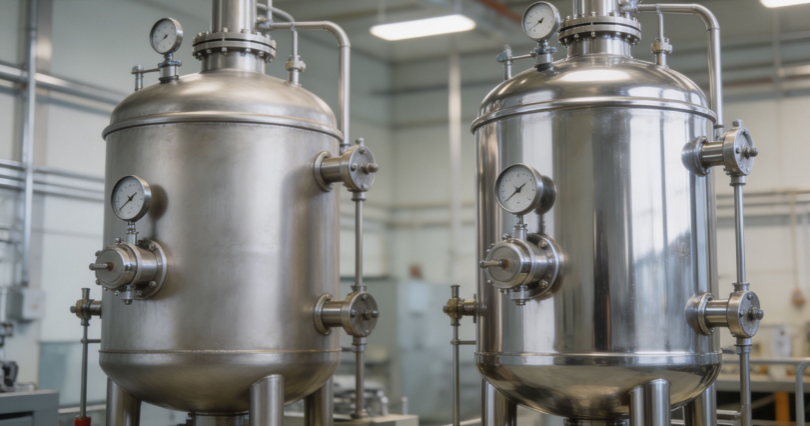
A project engineer once asked me why his 316L reactor had developed pinhole leaks after only eight months in service. The vessel was running a hydrochloric acid recovery process at 85°C. The material was correctly specified for the original process design. What had changed was the chloride concentration—a feedstock variation that nobody had flagged because 316L was supposed to handle chlorides.
That assumption cost the plant a six-figure reactor replacement and three weeks of downtime. The replacement vessel was titanium Grade 2. Five years later, it was still in service with no measurable wall loss.
The question “which is better” is the wrong question. Titanium and stainless steel are not competitors. They are materials built for different chemical battlefields. The right question is: what is your reactor fighting, and which material is engineered to survive that specific fight?
The Fundamental Difference
Stainless steel resists corrosion through a passive chromium oxide film. Type 316L, the most common grade for chemical reactors, contains 16–18% chromium, 10–14% nickel, and 2–3% molybdenum. The molybdenum improves resistance to chloride pitting, giving 316L a Pitting Resistance Equivalent Number (PREN = %Cr + 3.3×%Mo + 16×%N) of roughly 23–28. This is adequate for many chemical environments, but it has a ceiling. Above about 60°C in chloride-rich media, the passive film becomes unstable. Pitting initiates. Crevice corrosion follows. The 316L reactor that looked perfect on the outside can be developing pinholes from the inside.
Titanium Grade 2, the industry workhorse for chemical vessels, relies on a titanium dioxide passive film that is fundamentally different. It forms spontaneously in air or water, is stable across a wide pH range, and—critically—self-heals almost instantly if mechanically damaged in the presence of oxygen. Titanium’s PREN is roughly 40, well beyond any stainless steel. In oxidizing chloride environments, titanium is essentially immune to pitting and crevice corrosion. This is the single most important difference, and it dictates where each material belongs.
The table below lays out the essential comparison.
Parameter | 316L Stainless Steel | Titanium Grade 2 |
PREN | 23–28 | ~40 |
Yield strength (annealed) | ~170 MPa | ~275 MPa |
Density | ~8.0 g/cm³ | ~4.5 g/cm³ |
Thermal conductivity | 16–25 W/m·K | ~21.9 W/m·K |
Maximum service temperature (continuous) | ~870°C (dry air) | ~300°C (oxidizing); ~250°C recommended |
Chloride pitting resistance | Moderate (fails above ~60°C in high Cl⁻) | Near-immune in oxidizing conditions |
Resistance to reducing acids | Better than titanium | Poor—film breaks down |
Initial material cost | 1× (baseline) | 5–10× material; 3–8× fabricated vessel |
Typical applications | General chemical processing, organic solvents, neutral/alkaline media | Oxidizing chloride environments, wet chlorine, nitric acid, acetic acid + bromides |
Where Titanium Wins Decisively
Titanium dominates in oxidizing environments containing chlorides. A chlor-alkali plant handling wet chlorine at 80°C will measure titanium corrosion rates below 0.01 mm/year, while 316L in the same service corrodes at rates roughly 500 times higher. This is not a marginal difference. It is the difference between a reactor that operates for decades and one that fails within a year.
In purified terephthalic acid (PTA) production, oxidation reactors operate at roughly 230°C and 5 MPa in acetic acid containing bromides. Above 135°C, 316L suffers severe pitting within tens of hours. Industry design codes mandate titanium above this temperature threshold. Field data from PTA plants shows titanium reactors accumulating over 100,000 operating hours without failure.
For nitric acid service at any concentration, titanium outperforms stainless steel in corrosion resistance, though both materials are technically suitable. The decision often comes down to lifecycle cost rather than technical necessity.
In pharmaceutical and high-purity chemical manufacturing, titanium offers a secondary advantage that is often decisive: ion release rates below 0.1 μg/cm² per day, compared to measurable metal ion leaching from stainless steel. For products where metal contamination affects quality—sterile APIs, electronic-grade chemicals—this can justify the titanium premium on its own.
Where Stainless Steel Holds Its Ground
Stainless steel owns the territory of reducing acids and high-temperature oxidation. In hot concentrated hydrochloric acid or deaerated dilute sulfuric acid, titanium’s protective oxide film is thermodynamically unstable. The film dissolves, the titanium substrate corrodes rapidly, and in some conditions, hydrogen embrittlement becomes an additional failure mechanism. Hastelloy or other nickel-based alloys are the correct choice for these environments—not titanium, and not stainless steel alone.
For high-temperature gas-phase processes above 600°C, stainless steel’s continuous service rating of roughly 870°C in dry air makes it the practical choice. Titanium begins losing strength above roughly 300°C and oxidizes rapidly above 600°C. A reactor handling hot exhaust gases or superheated steam with modest corrosion loads is almost certainly stainless steel.
For general organic synthesis at moderate temperatures with no halides present, 316L is the economical choice. The corrosion resistance is adequate, the fabrication infrastructure is universal, and the initial cost is a fraction of titanium. Specifying titanium for a reactor that stirs toluene and methanol at 80°C is over-engineering that adds cost without adding value.
The Cost Equation
The material cost of titanium plate is roughly 5–10 times that of 316L by weight. However, titanium’s higher strength-to-weight ratio allows thinner wall sections under the same design pressure, partially offsetting the material premium. A titanium reactor vessel typically costs 3–8 times the price of an equivalent 316L vessel, depending on size, pressure rating, and complexity.
Fabrication costs add to the difference. Titanium welding requires full argon shielding of both the face and root sides until the weld zone cools below 200°C. Welders must be qualified to ASME Section IX for titanium. The machining hours for a titanium vessel are roughly 2–3 times those for stainless steel. Not every shop with stainless steel capability can fabricate titanium, and those that can charge accordingly.
The lifecycle cost argument for titanium depends on uptime and maintenance avoidance. In continuous processes where unplanned downtime costs thousands of dollars per hour, the reliability premium of titanium in its intended service environment often justifies the higher initial investment within the first few years of operation. In batch processes with moderate corrosion loads and lower utilization rates, 316L may deliver adequate service life at a fraction of the capital cost.
Decision Framework
If your process… | Choose |
Contains chlorides above 60°C in oxidizing conditions | Titanium Grade 2 or Grade 7 |
Involves wet chlorine, nitric acid, or acetic acid with bromides above 135°C | Titanium Grade 2 |
Handles hot concentrated HCl or deaerated dilute H₂SO₄ | Hastelloy or nickel alloy (not titanium, not stainless) |
Runs at 600–870°C in dry gas with low corrosion load | 316L or 310S stainless steel |
Processes general organic solvents at moderate temperatures | 316L (most economical) |
Requires minimum metal ion contamination (pharma, electronics) | Titanium Grade 1 or Grade 2 |
FAQ
Q: Can titanium and stainless steel be used together in the same reactor system?
A: Yes, and this is common practice. A titanium-steel clad reactor uses explosion bonding to metallurgically join a thin titanium layer (3–9 mm) to a carbon steel or stainless steel shell. The steel bears the pressure load. The titanium provides the corrosion barrier. This reduces cost compared to solid titanium while maintaining corrosion performance.
Q: What is titanium Grade 7, and when is it needed?
A: Titanium Grade 7 is Grade 2 with 0.12–0.25% palladium added. The palladium extends corrosion resistance into mildly reducing environments where standard Grade 2 would fail. It is specified for processes involving hydrochloric or sulfuric acid at moderate concentrations and temperatures where Grade 2 is marginal.
Q: Is stainless steel ever the better choice for corrosion resistance?
A: Yes, in reducing acid environments. Stainless steel’s chromium oxide film is more stable than titanium’s TiO₂ film in deaerated acids. For hot hydrochloric acid, stainless steel is inadequate, but nickel-based alloys are required—titanium is the wrong choice entirely.
Q: How long does a titanium reactor actually last?
A: In matched service—oxidizing chloride environments within the recommended temperature and pressure limits—a titanium reactor can operate for 20–30 years or more with minimal maintenance. The limiting factor is typically not corrosion but mechanical fatigue, hydrogen embrittlement risk in specific process conditions, or changes in process chemistry that move the reactor outside its safe operating envelope.
Summary
Titanium and stainless steel reactors serve different masters. Titanium exists for oxidizing chloride environments that would destroy stainless steel in months. Stainless steel covers the vast middle ground of chemical processing where chlorides are absent or temperatures are moderate, at a fraction of the cost.
The reactor that is “better” is the one whose material properties match the specific chemical environment, temperature, and pressure of the process it serves. The most expensive mistake is not choosing titanium when stainless steel would have worked. It is choosing stainless steel when the process chemistry guarantees it will fail, and discovering that guarantee through an unplanned shutdown.